Kawahara Equation
Overview
The Kawahara equation (also known as the dispersively-modified Kuramoto-Sivashinsky equation or Benney-Lin equation) is a nonlinear partial differential equation that describes the evolution of certain physical systems, particularly in fluid dynamics and plasma physics. It extends the Kuramoto-Sivashinsky equation by including higher-order dispersion terms.
The equation can be written in several forms depending on which dispersion terms are included:
First-order dispersion:
\[\frac{\partial u}{\partial t} = -\mu\frac{\partial^4 u}{\partial x^4} - \frac{\partial^2 u}{\partial x^2} - u\frac{\partial u}{\partial x} - \delta\frac{\partial u}{\partial x}\]
Third-order dispersion:
\[\frac{\partial u}{\partial t} = -\mu\frac{\partial^4 u}{\partial x^4} - \frac{\partial^2 u}{\partial x^2} - u\frac{\partial u}{\partial x} - \delta\frac{\partial^3 u}{\partial x^3}\]
Fifth-order dispersion:
\[\frac{\partial u}{\partial t} = -\mu\frac{\partial^4 u}{\partial x^4} - \frac{\partial^2 u}{\partial x^2} - u\frac{\partial u}{\partial x} - \nu\frac{\partial^5 u}{\partial x^5}\]
Combined dispersion (third and fifth order):
\[\frac{\partial u}{\partial t} = -\mu\frac{\partial^4 u}{\partial x^4} - \frac{\partial^2 u}{\partial x^2} - u\frac{\partial u}{\partial x} - \delta\frac{\partial^3 u}{\partial x^3} - \nu\frac{\partial^5 u}{\partial x^5}\]
where:
- $u(x, t)$ is the state variable
- $\mu$ is the viscosity coefficient (fourth-order diffusion)
- $\delta$ is the first-order or third-order dispersion coefficient
- $\nu$ is the fifth-order dispersion coefficient
- The term $-u\frac{\partial u}{\partial x}$ represents nonlinear advection
The Kawahara equation exhibits a rich variety of spatiotemporal behaviors including traveling waves, solitary waves, and chaotic dynamics. The higher-order dispersion terms provide additional stabilization mechanisms compared to the standard Kuramoto-Sivashinsky equation.
Model
For our analysis, we discretize the original PDE and separate the system into linear and nonlinear components:
\[\dot{\mathbf{u}}(t) = \mathbf{A}\mathbf{u}(t) + \mathbf{F}\mathbf{u}^{\langle 2\rangle}(t)\]
where:
- $\mathbf{A}$ is the linear operator (containing diffusion, anti-diffusion, and dispersion terms)
- $\mathbf{F}$ is the quadratic operator (for the nonlinear advection)
- $\mathbf{u}^{\langle 2\rangle}$ represents the quadratic states (non-redundant)
Conservation Forms
The implementation supports three different conservation forms for the nonlinear term:
- Non-Conservative (NC): $-u\frac{\partial u}{\partial x}$
- Conservative (C): $-\frac{1}{2}\frac{\partial (u^2)}{\partial x}$
- Energy-Preserving (EP): A skew-symmetric discretization that preserves discrete energy
The choice of conservation form affects the numerical properties and long-term behavior of the solution.
Numerical Integration
We integrate the Kawahara model using the Crank-Nicolson Adams-Bashforth (CNAB) method, treating the linear terms implicitly and the nonlinear term explicitly:
\[\mathbf{u}(t_{k+1}) = \begin{cases} \left(\mathbf{I} - \frac{\Delta t}{2}\mathbf{A}\right)^{-1}\left[\left(\mathbf{I} + \frac{\Delta t}{2}\mathbf{A}\right)\mathbf{u}(t_k) + \Delta t\mathbf{F}\left(\mathbf{u}(t_k)\right)^{\langle 2\rangle}\right] & k = 1 \\[0.3cm] \left(\mathbf{I} - \frac{\Delta t}{2}\mathbf{A}\right)^{-1}\left[\left(\mathbf{I} + \frac{\Delta t}{2}\mathbf{A}\right)\mathbf{u}(t_k) + \frac{3\Delta t}{2}\mathbf{F}\left(\mathbf{u}(t_k)\right)^{\langle 2\rangle} - \frac{\Delta t}{2}\mathbf{F}\left(\mathbf{u}(t_{k-1})\right)^{\langle 2\rangle}\right] & k \geq 2 \end{cases}\]
This scheme provides second-order accuracy in time and good stability properties for the stiff linear terms.
Finite Difference Model
We discretize the spatial derivatives using centered finite differences. The discretization depends on the dispersion order:
For first-order dispersion ($\delta \partial_x u$):
\[u_x \approx \frac{1}{2\Delta x}(u_{n+1} - u_{n-1})\]
For third-order dispersion ($\delta \partial_x^3 u$):
\[u_{xxx} \approx \frac{1}{2\Delta x^3}(u_{n+2} - 2u_{n+1} + 2u_{n-1} - u_{n-2})\]
For fifth-order dispersion ($\nu \partial_x^5 u$):
\[u_{xxxxx} \approx \frac{1}{2\Delta x^5}(u_{n+3} - 4u_{n+2} + 5u_{n+1} - 5u_{n-1} + 4u_{n-2} - u_{n-3})\]
For the fourth-order diffusion:
\[u_{xxxx} \approx \frac{1}{\Delta x^4}(u_{n+2} - 4u_{n+1} + 6u_n - 4u_{n-1} + u_{n-2})\]
For the anti-diffusion:
\[u_{xx} \approx \frac{1}{\Delta x^2}(u_{n+1} - 2u_n + u_{n-1})\]
The linear operator $\mathbf{A}$ combines all these terms into a sparse matrix with periodic boundary conditions, resulting in a circulant-like structure.
The quadratic operator $\mathbf{F}$ discretizes the nonlinear advection term according to the chosen conservation form.
Example - Third-order Dispersion
using CairoMakie
using LinearAlgebra
using PolynomialModelReductionDataset: KawaharaModel

# Settings
Ω = (0.0, 50.0)
dt = 0.01
N = 256
kawahara = KawaharaModel(
    spatial_domain=Ω, time_domain=(0.0, 150.0),
    params=Dict(:mu => 1.0, :delta => 0.15, :nu => 0.0),
    dispersion_order=3,
    conservation_type=:C,
    Δx=(Ω[2] - 1/N)/N, Δt=dt
)
DS = 100
L = kawahara.spatial_domain[2]

# Initial condition
a = 1.0
b = 0.1
u0 = a*cos.((2*π*kawahara.xspan)/L) + b*cos.((4*π*kawahara.xspan)/L)

# Operators
A, F = kawahara.finite_diff_model(kawahara, kawahara.params[:mu], kawahara.params[:delta])

# Integrate
U = kawahara.integrate_model(
    kawahara.tspan, u0, nothing;
    linear_matrix=A, quadratic_matrix=F, const_stepsize=true
)

# Heatmap
fig1, ax, hm = CairoMakie.heatmap(kawahara.tspan[1:DS:end], kawahara.xspan, U[:, 1:DS:end]')
ax.xlabel = L"t"
ax.ylabel = L"x"
CairoMakie.Colorbar(fig1[1, 2], hm)
fig1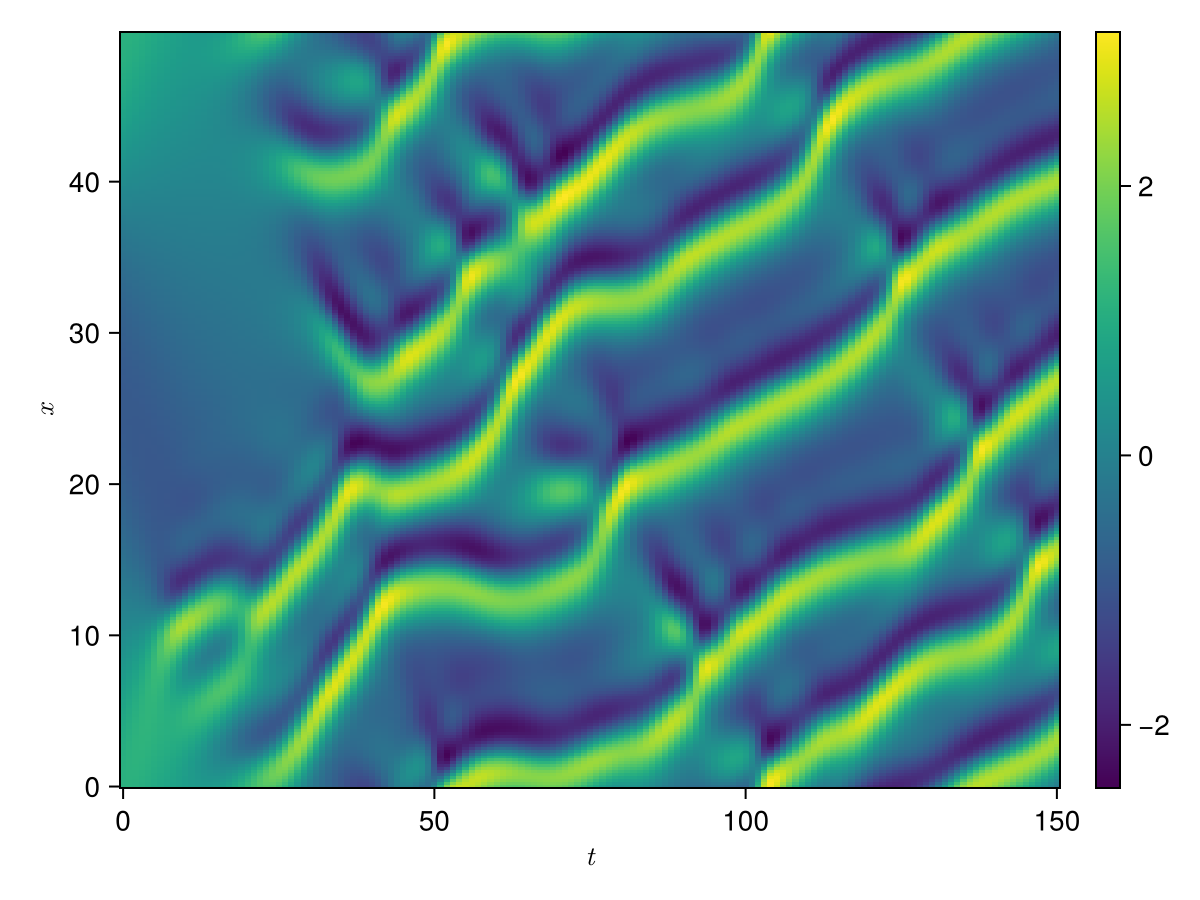
# Surface plot
fig2, _, sf = CairoMakie.surface(kawahara.xspan, kawahara.tspan[1:DS:end], U[:, 1:DS:end],
    axis=(type=Axis3, xlabel=L"x", ylabel=L"t", zlabel=L"u(x,t)"))
CairoMakie.Colorbar(fig2[1, 2], sf)
fig2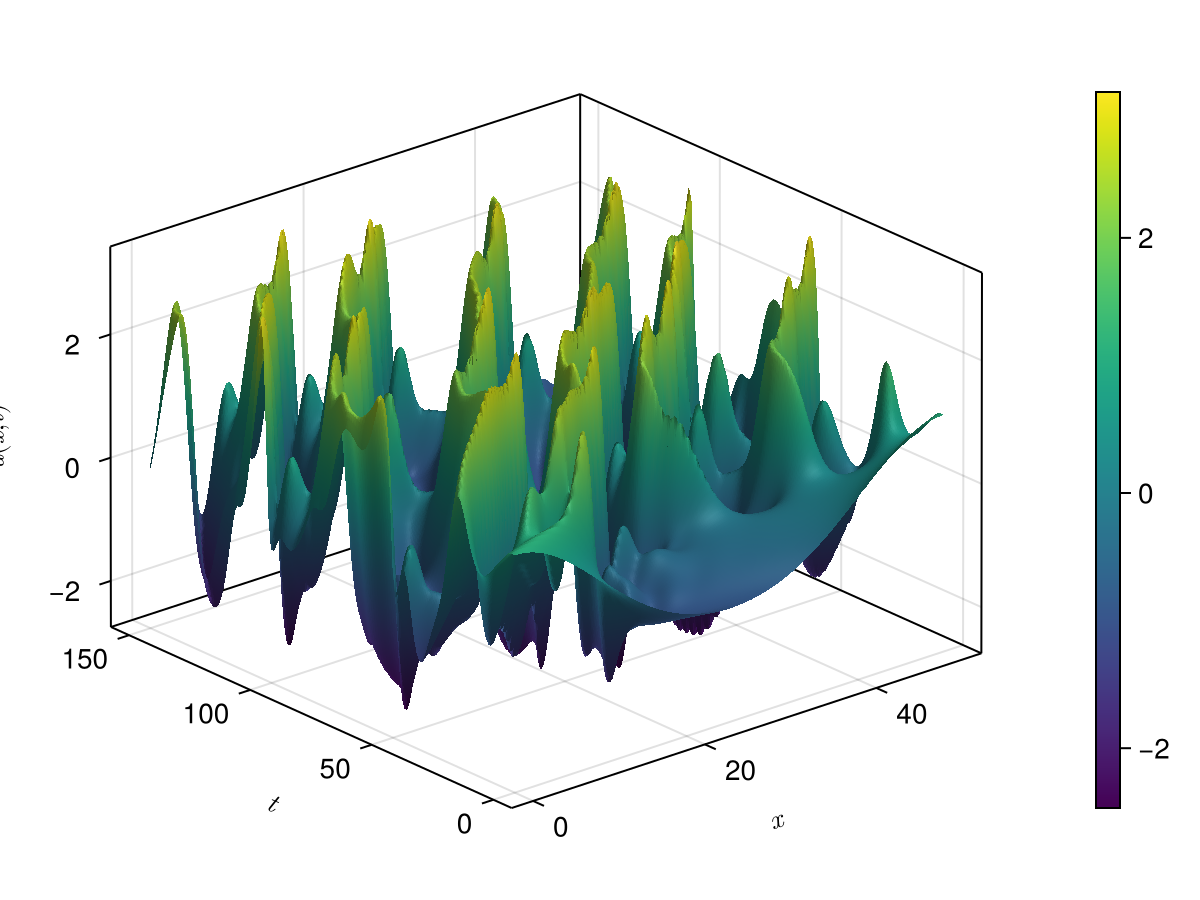
Example - Fifth-order Dispersion
using CairoMakie
using LinearAlgebra
using PolynomialModelReductionDataset: KawaharaModel

# Settings
Ω = (0.0, 50.0)
dt = 0.01
N = 256
kawahara = KawaharaModel(
    spatial_domain=Ω, time_domain=(0.0, 150.0),
    params=Dict(:mu => 1.0, :delta => 0.0, :nu => 0.05),
    dispersion_order=5,
    conservation_type=:EP,
    Δx=(Ω[2] - 1/N)/N, Δt=dt
)
DS = 100
L = kawahara.spatial_domain[2]

# Initial condition
a = 1.0
b = 0.1
u0 = a*cos.((2*π*kawahara.xspan)/L) + b*cos.((4*π*kawahara.xspan)/L)

# Operators
A, F = kawahara.finite_diff_model(kawahara, kawahara.params[:mu], kawahara.params[:delta], kawahara.params[:nu])

# Integrate
U = kawahara.integrate_model(
    kawahara.tspan, u0, nothing;
    linear_matrix=A, quadratic_matrix=F, const_stepsize=true
)

# Heatmap
fig3, ax, hm = CairoMakie.heatmap(kawahara.tspan[1:DS:end], kawahara.xspan, U[:, 1:DS:end]')
ax.xlabel = L"t"
ax.ylabel = L"x"
CairoMakie.Colorbar(fig3[1, 2], hm)
fig3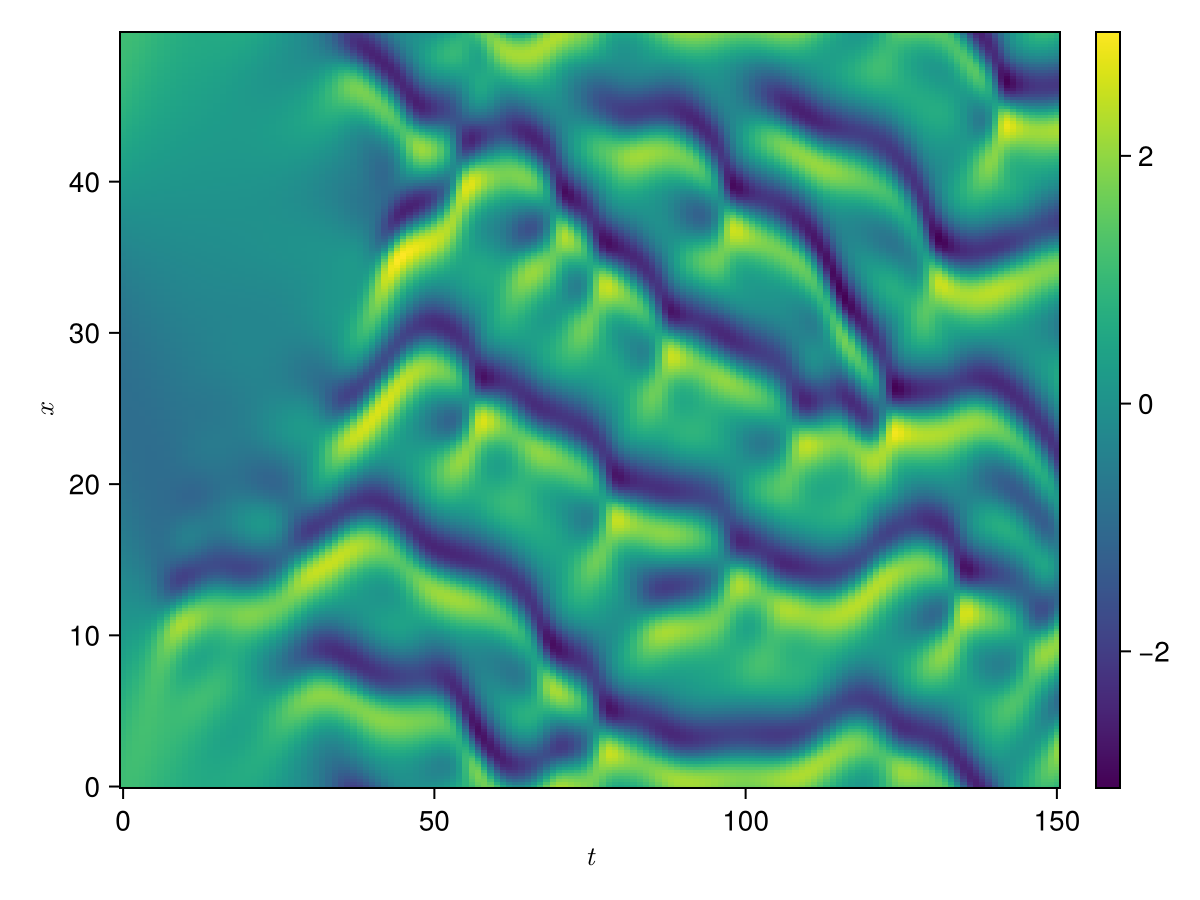
API
PolynomialModelReductionDataset.Kawahara.KawaharaModel — Type
mutable struct KawaharaModel <: AbstractModelKawahara equation model (also known as dispersively-modified Kuramoto-Sivashinsky equation or Benney-Lin equation) is a nonlinear PDE that describes the evolution of certain physical systems, such as fluid dynamics and plasma physics. The equation can be written in several forms, including:
\[\frac{\partial u}{\partial t} = -\mu\frac{\partial^4 u}{\partial x^4} - \frac{\partial^2 u}{\partial x^2} - u\frac{\partial u}{\partial x} - \delta\frac{\partial u}{\partial x}\]
or
\[\frac{\partial u}{\partial t} = -\mu\frac{\partial^4 u}{\partial x^4} - \frac{\partial^2 u}{\partial x^2} - u\frac{\partial u}{\partial x} - \delta\frac{\partial^3 u}{\partial x^3}\]
or
\[\frac{\partial u}{\partial t} = -\mu\frac{\partial^4 u}{\partial x^4} - \frac{\partial^2 u}{\partial x^2} - u\frac{\partial u}{\partial x} - \nu\frac{\partial^3 u}{\partial x^5}\]
or
\[\frac{\partial u}{\partial t} = -\mu\frac{\partial^4 u}{\partial x^4} - \frac{\partial^2 u}{\partial x^2} - u\frac{\partial u}{\partial x} - \delta\frac{\partial^3 u}{\partial x^3} - \nu\frac{\partial^5 u}{\partial x^5}\]
where $u$ is the state variable, $\mu$ is the viscosity coefficient, $\delta$ is the 1st or 3rd order dispersion coefficient, and $\nu$ is the 5th order dispersion coefficient.
Fields
spatial_domain::Tuple{Real,Real}: spatial domaintime_domain::Tuple{Real,Real}: temporal domainparam_domain::Dict{Symbol,Tuple{Real,Real}}: parameter domainsΔx::Real: spatial grid sizeΔt::Real: temporal step sizeBC::Symbol: boundary conditionIC::Array{Float64}: initial conditionxspan::Vector{Float64}: spatial grid pointstspan::Vector{Float64}: temporal pointsparams::Dict{Symbol,<:Union{<:Real,<:AbstractArray{<:Real}}}: parameters (diffusion and dispersion coefficients)fourier_modes::Vector{Float64}: Fourier modesspatial_dim::Int64: spatial dimensiontime_dim::Int64: temporal dimensionparam_dim::Dict{Symbol,Int64}: parameter dimensionsconservation_type::Symbol: conservation typefinite_diff_model::Function: finite difference modelintegrate_model::Function: integratorjacobian::Function: Jacobian matrix
PolynomialModelReductionDataset.Kawahara — Module
Kawahara or Dispersively-Modified Kuramoto-Sivashinsky Equation modelPolynomialModelReductionDataset.Kawahara.finite_diff_model — Function
finite_diff_model(model, μ, δ)
finite_diff_model(model, μ, δ, ν)
Finite Difference Model for the Kuramoto-Sivashinsky equation.
Arguments
model::KawaharaModel: Kuramoto-Sivashinsky equation modelμ::Real: parameter value
Returns
A: A matrixF: F matrix
PolynomialModelReductionDataset.Kawahara.finite_diff_periodic_conservative_model — Function
finite_diff_periodic_conservative_model(N, Δx, μ, δ, ord)
finite_diff_periodic_conservative_model(N, Δx, μ, δ, ord, ν)
Finite Difference Model for the Kuramoto-Sivashinsky equation with periodic boundary condition.
PolynomialModelReductionDataset.Kawahara.finite_diff_periodic_energy_preserving_model — Function
finite_diff_periodic_energy_preserving_model(
    N,
    Δx,
    μ,
    δ,
    ord
)
finite_diff_periodic_energy_preserving_model(
    N,
    Δx,
    μ,
    δ,
    ord,
    ν
)
Finite Difference Model for the Kuramoto-Sivashinsky equation with periodic boundary condition.
PolynomialModelReductionDataset.Kawahara.finite_diff_periodic_nonconservative_model — Function
finite_diff_periodic_nonconservative_model(N, Δx, μ, δ, ord)
finite_diff_periodic_nonconservative_model(
    N,
    Δx,
    μ,
    δ,
    ord,
    ν
)
Finite Difference Model for the Kuramoto-Sivashinsky equation with periodic boundary condition.
PolynomialModelReductionDataset.Kawahara.integrate_finite_diff_model — Method
integrate_finite_diff_model(tdata, IC, args; kwargs...)
Integrator using Crank-Nicholson Adams-Bashforth method for (FD).
Arguments
tdata: temporal pointsIC: initial condition
Keyword Arguments
linear_matrix: linear matrixquadratic_matrix: quadratic matrixconst_stepsize: whether to use a constant time step sizeu2_jm1: u2 at j-1
Returns
u: state matrix